Cactus leather is neither leather nor pure cactus. What is really inside, how it is made, what it can take and its real impact.
Benoit H.Founder
Updated · 4 min read
Cactus leather is neither leather nor pure cactus. It is a coating of 35% cactus powder and 65% bio-PU, laid on a cotton-polyester backing. According to a life cycle assessment carried out by Fairly Made in 2023, producing it emits around 17 times less CO₂ per square metre than producing animal leather. Here is what is inside, how it is made and what it can take.
What exactly is “cactus leather”?
Cactus leather is a material with the look, grain and suppleness of leather, with nothing animal in it.
It starts with nopal, the prickly pear cactus grown in Mexico. Its pads are dried, ground into powder, then bound with a resin to form a continuous surface. That surface is coated onto a textile that gives it structure.
The result looks like a smooth, matte skin. It cuts and stitches like one. Our cactus models are certified vegan by PETA and The Vegan Society.
Why does MOEA never say “cactus leather”?
Because the law does not allow it. In France, the word “cuir” (leather) is reserved for materials made from animal hide (decree of 8 January 2010). Using it to describe or sell a plant-based material is prohibited.
So why this title? Because “cactus leather” is the term everyone knows. The one you searched for to get here. We use it freely in this article, and only here, to explain what it covers. It is not our vocabulary.
On our site and our product pages, the material has its own name: CactusSkin. An accurate name, for a material that does not need to borrow someone else's.
How much cactus is really in cactus leather?
35% of the surface layer. It is the question we get most. Here is the full spec, exactly as it appears on our products.
Layer
Composition
Role
Coating (surface)
35% cactus + 65% bio-PU
Look, feel, wear resistance
Backing (reverse)
55% polyester + 45% cotton
Structure and hold
The binder is bio-PU: a polyurethane made from a polyol of plant origin, usually corn, rather than a fossil one. It is still a polyurethane, so a polymer. There is plastic in cactus leather, and the polyester backing is plastic too. Without a binder, cactus powder does not hold together: the binder is what makes it a material. The real question is not “is there plastic?” but “how much, and where does it come from?”.
Our advice
always ask for the full composition of a plant-based material, binder included.
How is cactus leather made?
From nopal to powder.
Harvest. Nopal pads are cut in Mexico every six to eight months. Only mature pads are taken: the plant is not damaged and keeps growing.
Drying. The pads dry in the open air for three days.
Powder. Once dry, they are ground into a fine powder.
Coating. The powder travels to Italy. There it is mixed with bio-PU, then coated onto the textile backing.
Assembly. The material then arrives in Porto, where our sneakers are made.
The making of CactusSkin.
Shop the story
RUSH
$246.00
CACTUS
ORIGIN
$218.00
CACTUS
Is cactus leather durable?
The right question. A material that breaks ends up as waste, whatever its origin.
Like all our biomaterials, CactusSkin goes through lab flex tests before it enters our collections. It is only approved if it withstands thousands of cycles without a single defect.
What we won't tell you: how many years your pair will last. We have not run a wear test on this material, and a sneaker's lifespan depends first on how it is worn and cared for. The weak point of a coated material is a cut: a clean cut can spread. Keep clear of sharp edges.
Can cactus leather handle rain? How do you care for it?
It is not waterproof. But it handles everyday rain. One rule only: never submerge your pair in water.
Care is simple:
a soft brush and soapy water for the surface and textile parts;
air-dry at room temperature;
never a radiator, hairdryer or direct sun;
never the washing machine: only the laces go in.
Our advice
rotate with another pair and let your sneakers rest 48 hours between wears, especially after a rainy day.
Cactus leather vs animal leather: what is the impact?
According to a life cycle assessment (LCA) carried out by Fairly Made in 2023, producing one square metre of CactusSkin emits around 3.61 kg CO₂e, against around 60.8 kg CO₂e for one square metre of animal leather. Around 17 times less.
This figure compares how the two materials are made, not the full life of a pair. And on a sneaker, cactus is only part of the upper. Our calculation method, its sources and its limits are detailed on our LCA and carbon footprint page.
Which MOEA cactus sneakers to choose?
Two, in the current collection. Cactus stays in our range, in small runs.
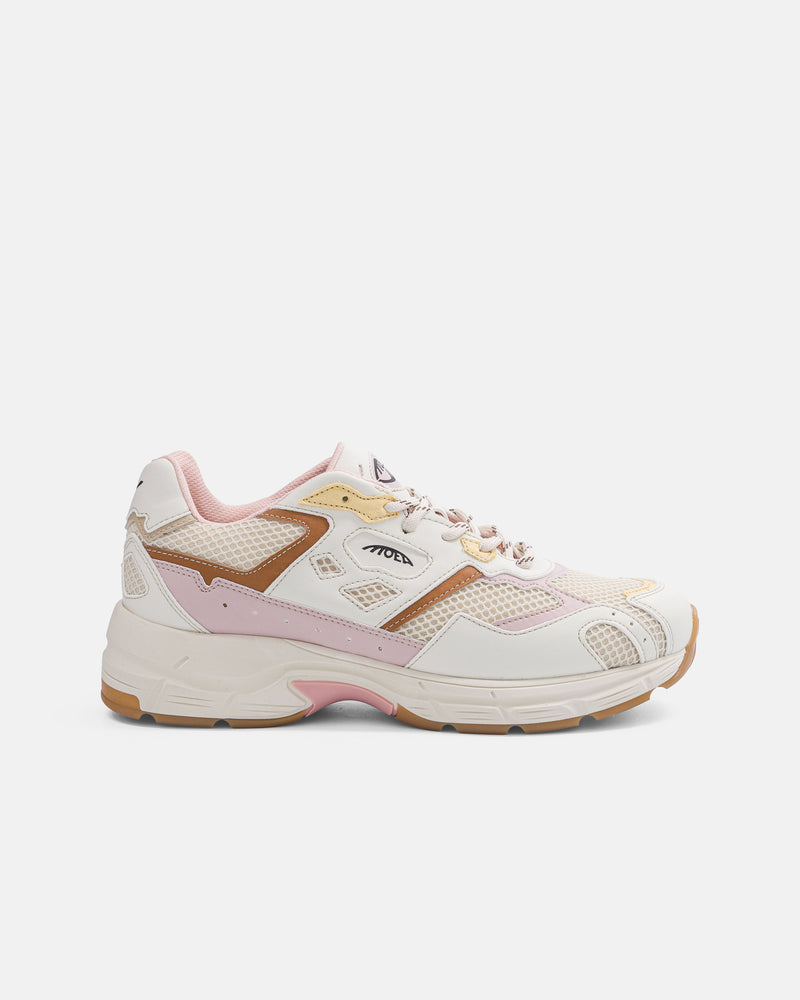
Rush Green Acid, for the silhouette. A 90s runner, volume and all. Dark green and khaki CactusSkin on the panels, combined with corn-based bio-PU, a PU and polyamide panel and a recycled cotton and polyester mesh. Ultra-light TR sole.
Origin Full Aloe Suede, for the line. A clean low-top in all-over aloe green, where cactus sits next to a microsuede (polyurethane and polyamide). Rubber sole with 20% recycled content, organic and recycled cotton laces.
In both, cactus is only part of the upper. The full composition, piece by piece, is on each product page. Both are made in Porto.
To see how other plant-based materials compare, read our article on biomaterials.
FAQ
Does cactus leather contain plastic?
Yes. The coating contains 65% bio-PU, a polyurethane made from a plant-based polyol, and the backing contains 55% polyester.
Can you call it cactus “leather”?
Not to sell it. In France, the word “leather” is reserved for materials of animal origin. That is why, at MOEA, the material is called CactusSkin.
Is cactus leather waterproof?
No, but it handles everyday rain. Never submerge your pair, and let it air-dry.
How do you clean cactus sneakers?
With a soft brush and soapy water, then air-dry away from any heat source. Never in the washing machine.
Where is CactusSkin made?
The cactus is grown in Mexico, the material is made in Italy, and our sneakers are assembled in Porto. They are certified vegan by PETA and The Vegan Society.
By signing up, you confirm that you have read and understood our Privacy Policy and agree to receive our newsletter and other marketing communications.
CERTIFICATIONS
NEWSLETTER
-10% on you first purchase
By signing up, you confirm that you have read and understood our Privacy Policy and agree to receive our newsletter and other marketing communications.